
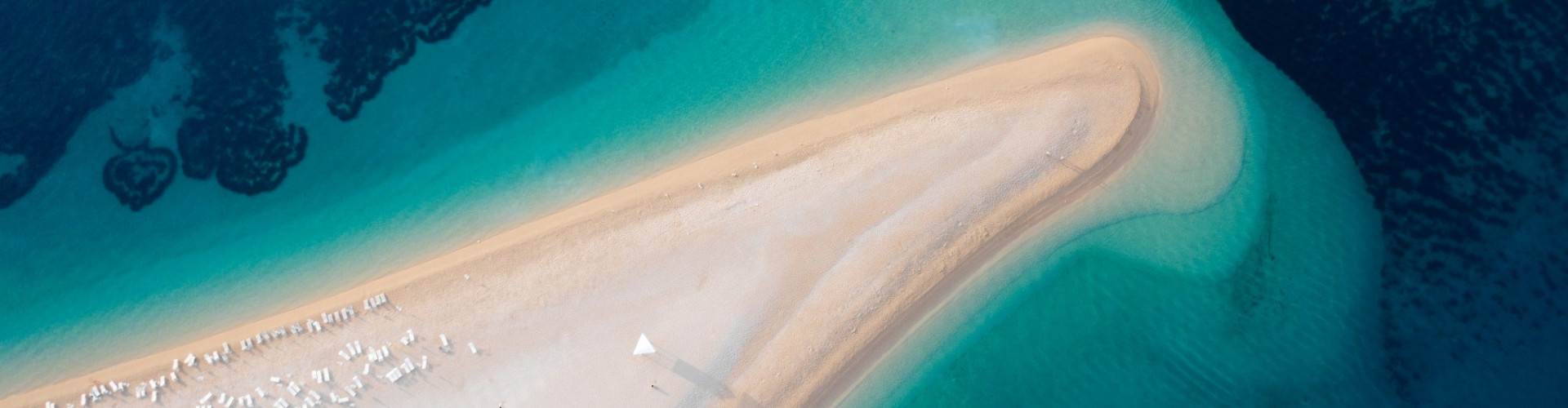
Croatia
Croatia, A Coastline Designed for Sailing
Seen from the sea, Croatia immediately reveals what makes it unique in the Mediterranean. The coastline does not unfold as a single line, but as a dense sequence of islands, peninsulas, narrow channels, and protected passages. Land and sea overlap continuously, creating a sailing environment where movement feels guided rather than exposed.
Stretching along the eastern Adriatic, Croatia faces Italy across relatively short distances, sheltered by an extensive island belt that runs parallel to the mainland. This natural barrier softens sea conditions and creates one of the most navigable coastlines in Europe. For long stretches, it is possible to sail without losing sight of land, moving from harbor to harbor through calm waters shaped by geography rather than infrastructure.
The heart of Croatian sailing lies along the Dalmatian coast. Here, historic stone towns sit directly at the water’s edge, while islands rise just offshore, forming natural corridors ideal for short daily sails. The result is a coastline that feels intentionally designed for navigation, even though its form is entirely natural. Distances are manageable, routes are flexible, and alternatives are always available if conditions change.
Why choose Croatia as a sailing destination?
Because it offers continuity without monotony. Each island and coastal town feels distinct, yet part of a coherent system. Croatia is not about reaching a single highlight. It is about moving smoothly through a landscape where sailing is not an activity added to the destination, but the most natural way to experience it.


Sailing Croatia, Island Hopping as a Natural Route System
Sailing along the Croatian coast follows an intuitive logic shaped by geography rather than by marinas or infrastructure. Islands run parallel to the mainland, creating a network of protected channels where routes can be adjusted daily without long open-sea passages. This makes Croatia exceptionally flexible, whether the goal is a relaxed cruise or a more ambitious itinerary.
Central Dalmatia is the core sailing area. Routes commonly move between Hvar, Brač, and Korčula, with short legs that allow late departures and early arrivals. Anchorages and town harbors are evenly spaced, so plans can shift easily with wind, mood, or crowd levels. Navigation is mostly visual, and alternatives are always close by.
Moving north, the Šibenik and Zadar regions introduce narrower passages and inland waterways. Sailing here feels more enclosed and quieter, with national parks and low-lying islands replacing busier resort towns. These routes suit crews looking for nature-focused days and calm nights at anchor, often without sacrificing access to small ports for supplies.
Further south, the coast around Dubrovnik becomes more dramatic and slightly more exposed. Distances increase, scenery turns steeper, and planning becomes more deliberate. Even here, island cover remains present, keeping conditions manageable while adding a sense of progression to the route.
Is Croatia suitable for first-time sailors?
Yes. Predictable conditions, short distances, and abundant stopping points make it one of the most accessible sailing destinations in Europe. At the same time, experienced crews can extend passages, explore less frequented islands, or sail longer legs without leaving the same coastal system.
IntersailClub typically treats Croatia as a modular destination. Routes can be scaled up or down easily, combining calm island hopping with optional longer crossings, all within a coastline that consistently supports navigation rather than challenging it.


Stone Towns, Maritime Republics, and Coastal Identity
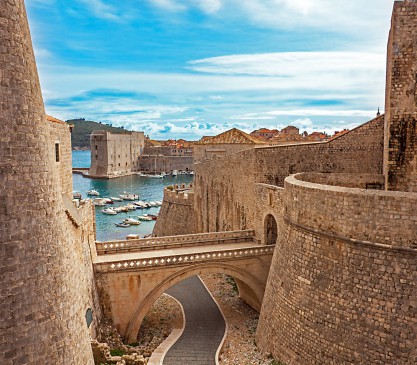
Croatia’s coastal culture has been shaped by navigation as much as by land. For centuries, towns developed as maritime outposts rather than inland centers, with harbors acting as the focal point of economic, social, and defensive life. This history remains clearly visible today, especially along the Dalmatian coast, where stone architecture dominates the waterfront.
Cities such as Dubrovnik and Korčula grew as independent or semi-independent maritime powers, trading across the Adriatic and beyond. Their fortified walls, narrow streets, and compact harbors reflect a need for protection and control rather than expansion. Even smaller island towns follow the same pattern, built directly around sheltered bays with immediate access to the sea.
Venetian influence is particularly strong. For centuries, the Adriatic functioned as an internal sea of the Venetian Republic, and its architectural and cultural imprint remains widespread. Stone palaces, loggias, and bell towers line the coast, adapted to salt, wind, and constant exposure. At the same time, Slavic traditions and local island customs shaped daily life, creating a layered identity rather than a single dominant culture.
Fishing, olive cultivation, and wine production continue to define coastal rhythms, especially outside peak season. Markets, boatyards, and small ports remain active parts of community life, not just tourist backdrops. Festivals and religious celebrations are often tied to maritime calendars, with processions and events that start or end at the harbor.
What defines Croatia’s coastal identity today? Continuity. Tourism has added scale and visibility, but it has not erased the fundamental relationship between towns and the sea. Sailing reinforces this connection, revealing how settlements, routes, and culture all align with access by water.
Climate and Sailing Conditions Along the Croatian Coast
June is the hottest month in Havana with an average temperature of 27°C (81°F) and the coldest is January at 21°C (70°F) with the most daily sunshine hours at 11 in July. The wettest month is June with an average of 80mm of rain. The best month to swim in the sea is in August when the average sea temperature is 30°C (86°F).
Check all Statistics in AccuweatherDec
Jan
Feb
Mar
Apr
May
Jun
Jul
Aug
Sep
Oct
Nov
All destinations in Mediterranean Sea
-

-
-
-
-
-
-
-
-
-
-
-
-
-
-
-
-
-
-
-
-
-
-
-
-
-
-
-
-
-
-


