
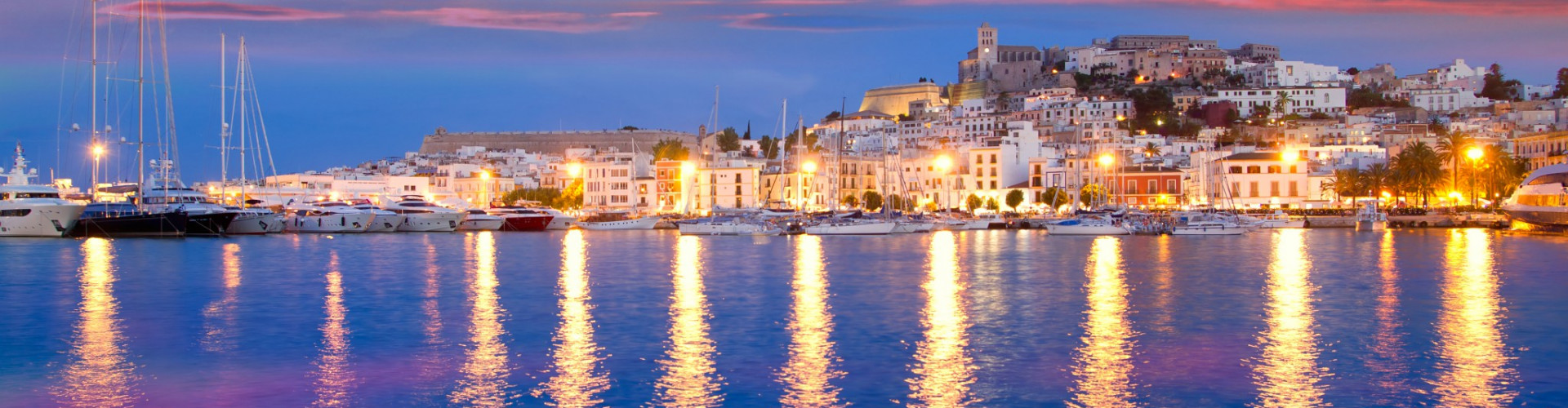
Ibiza
Ibiza, An Island of Contrasts Between Sea and Stone
Seen from the sea, Ibiza is not the island many expect. Before the sound systems, beach clubs, and nightlife narratives, Ibiza appears rugged and elemental. Pine-covered hills fall abruptly into rocky headlands, calas open suddenly between cliffs, and the fortified silhouette of Dalt Vila rises above the harbor as it has for centuries. Approaching by water reveals an island defined less by spectacle and more by geography.
Ibiza lies in the western Mediterranean, part of the Balearic archipelago, positioned between mainland Spain and the wider basin of open sea leading toward Sardinia and North Africa. Its location has made it a point of passage since Phoenician times, shaping a layered identity where maritime trade, defense, and cultural exchange left tangible marks. Inland, dry-stone walls divide fields of almond and olive trees, while coastal paths trace a shoreline that alternates between exposure and shelter.
Unlike smaller neighbors, Ibiza holds multiple identities at once. Fishing villages, rural fincas, luxury enclaves, and seasonal nightlife coexist within a compact territory. Beaches such as Cala d’Hort or Cala Conta shift character with light and wind, while the interior remains quiet even at peak season. The island’s scale allows rapid transitions, from isolated anchorages to busy ports within short distances.
Why visit Ibiza beyond its reputation?
Because the island offers range. It can be social or solitary, raw or curated, depending on how it is approached. Ibiza is not a single experience but a collection of overlapping landscapes and rhythms, best understood when movement, rather than destination, becomes the focus.


Sailing Ibiza, Calas, Headlands, and Short Mediterranean Passages
Sailing around Ibiza reveals an island designed for coastal exploration. Distances are short, navigation is mostly visual, and the coastline offers a high density of anchorages relative to its size. Rather than long passages, sailing here is defined by frequent stops and the ability to adapt plans quickly to wind and crowd conditions.
The western coast is among the most popular sailing areas, with calas such as Cala Conta, Cala Tarida, and Cala d’Hort offering sandy bottoms, clear holding, and dramatic sunsets. The presence of offshore islets like Es Vedrà adds navigational reference points and visual drama. This side of the island is relatively exposed to westerly winds, making early departures and flexible timing important during summer afternoons.
The southern coast provides more shelter and easier access to ports. Anchorages near Ses Salines and Es Cavallet sit close to long beaches and shallow waters, while marinas such as Ibiza Town allow quick transitions between sea and shore. Sailing eastward, the coastline becomes rockier and less developed, with fewer but quieter stopping points.
Is Ibiza good for sailing?
Yes, particularly for those who enjoy variety within short distances. Catamarans and small cruising sailboats are common, and skippered itineraries are often preferred during peak season to manage anchoring rules and traffic. IntersailClub generally treats Ibiza as a modular destination, combining calm anchorages, open stretches, and optional crossings to nearby Formentera rather than focusing on mileage.
Here, sailing is not about escape from civilization but about choosing when and how to engage with it.



Layers of History Beneath Ibiza’s Modern Image
Ibiza’s cultural depth is often obscured by its contemporary fame, yet the island’s identity is rooted in centuries of maritime history. Founded by the Phoenicians in the 7th century BC, Ibiza developed as a trading post long before tourism reshaped its economy. This legacy remains visible in Dalt Vila, the fortified old town overlooking the harbor, whose walls reflect successive periods of conquest and defense.
For centuries, life in Ibiza revolved around self-sufficiency. Limited resources encouraged small-scale agriculture, fishing, and dispersed rural settlements. Traditional fincas were built to withstand heat and isolation, while coastal watchtowers guarded against piracy. These structures still punctuate the landscape, reminders of an island shaped by necessity rather than abundance.
In the 20th century, Ibiza attracted artists, musicians, and countercultural communities drawn by its light and relative isolation. This wave influenced music, design, and social norms, creating a reputation for openness that later merged with global nightlife culture. Local traditions, however, persisted alongside these changes. Festivals tied to village saints, folk dances, and seasonal rituals remain part of everyday life away from the main resorts.
What cultural influences shape Ibiza’s identity today?
Continuity and contrast. Ancient trade routes, rural resilience, creative experimentation, and global tourism coexist rather than replace one another. Sailing reinforces this understanding, revealing how the island’s history is etched into its coastline, ports, and defensive landmarks.
Ibiza’s culture is not a performance. It is layered, sometimes contradictory, and deeply linked to the sea that has always connected the island to the wider Mediterranean.
Climate and Sailing Conditions Around Ibiza
June is the hottest month in Havana with an average temperature of 27°C (81°F) and the coldest is January at 21°C (70°F) with the most daily sunshine hours at 11 in July. The wettest month is June with an average of 80mm of rain. The best month to swim in the sea is in August when the average sea temperature is 30°C (86°F).
Check all Statistics in AccuweatherDec
Jan
Feb
Mar
Apr
May
Jun
Jul
Aug
Sep
Oct
Nov
All destinations in Mediterranean Sea
-

-
-
-
-
-
-
-
-
-
-
-
-
-
-
-
-
-
-
-
-
-
-
-
-
-
-
-
-
-
-


