
Stromboli
Stromboli, Sailing Beside an Active Volcano
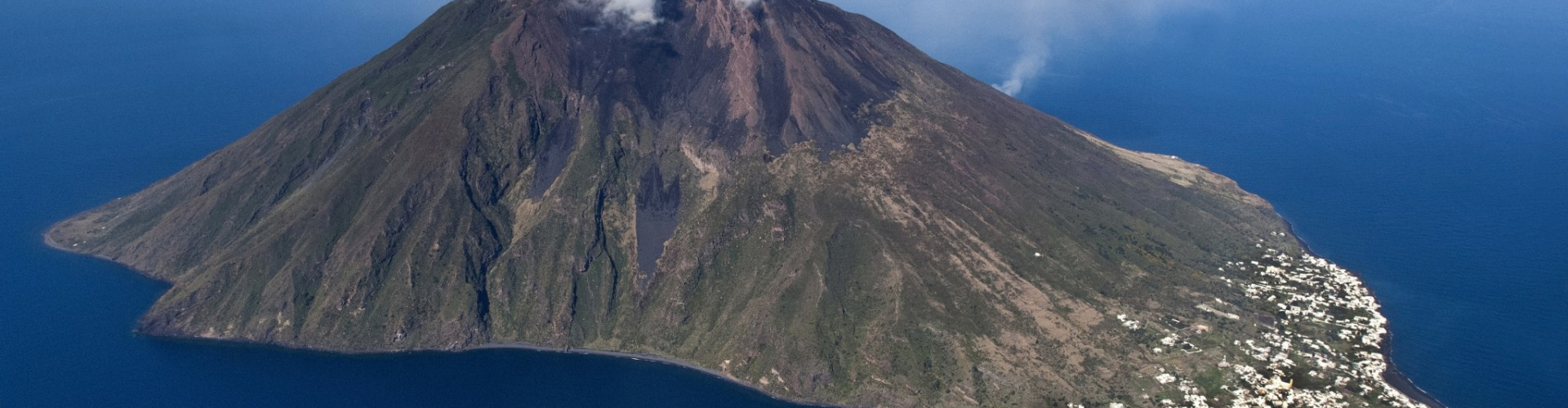
Approaching from open water, Stromboli is unmistakable. Its near-perfect volcanic cone rises directly from the Tyrrhenian Sea, dark against the horizon. Unlike other islands where relief softens toward the coast, Stromboli feels immediate and vertical. The shoreline is narrow, composed of black sand and lava rock, with whitewashed houses clustered low along the water’s edge.
Part of the Aeolian Islands, north of Sicily, Stromboli is one of Europe’s most active volcanoes. Its regular eruptions, often visible at night, define the island’s identity. Sailing here is not just coastal navigation. It is proximity to a living geological process.
The island’s small scale reinforces this intensity. There is no sprawling development, no extended marina complex, and no urban sprawl. Settlement is concentrated along a limited stretch of coast, while the rest of the island remains dominated by steep volcanic slopes and the Sciara del Fuoco, a dramatic lava slope descending into the sea.
Why sail to Stromboli?
Because it offers singularity. Few sailing destinations combine active geology, open-sea setting, and navigable proximity in such a concentrated form.


Sailing Stromboli, Open Approaches and Nighttime Spectacle
Sailing to Stromboli introduces a stronger open-water dimension compared to other Aeolian islands. The island sits exposed in the northeastern part of the archipelago, and crossings require attention to forecast and wind direction.
Approaches are typically made from Lipari, Salina, or Panarea. The final leg often feels panoramic, with Stromboli gradually dominating the skyline. The main anchorage lies along the eastern side near the village, where boats can anchor in suitable conditions with adequate spacing from shore and ferry routes.
Protection is limited and highly dependent on wind. Mistral conditions can create uncomfortable swell, while calmer summer patterns allow stable overnight anchoring. The seabed deepens quickly, and anchoring requires precise positioning.
One of the most distinctive sailing experiences in the Mediterranean occurs here after sunset. Boats often anchor offshore to observe Stromboli’s eruptions from the water. Lava fragments glow red against the night sky, occasionally sliding down the Sciara del Fuoco toward the sea. The experience is quiet, visual, and elemental rather than dramatic in scale.
Is Stromboli suitable for all sailors?
It is manageable, but requires preparation. Distances between islands are short, yet exposure demands forecast awareness. Skippered yachts are common for those seeking flexibility in changing conditions. IntersailClub typically integrates Stromboli as a highlight within Aeolian itineraries, aligning arrival timing with weather stability and nighttime visibility.
Here, sailing is about perspective rather than speed.


Fire, Myth, and Island Continuity
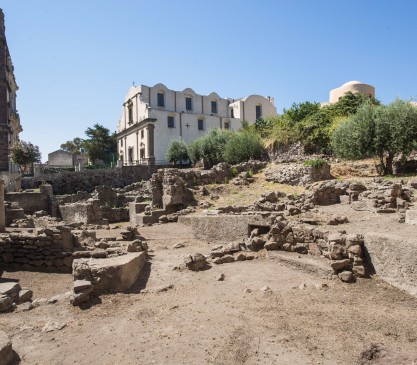
Stromboli has long been associated with mythology and navigation. Ancient sailors used its constant glow as a natural lighthouse, a reference point in open water. The island’s name itself is linked to its persistent volcanic activity.
Unlike more developed islands, Stromboli remains structurally simple. The village retains white cubic houses, narrow paths, and minimal vehicular presence. Fishing continues alongside tourism, and daily life adapts to the volcano’s rhythm rather than attempting to dominate it.
What defines Stromboli’s identity today?
Coexistence with activity. Residents and visitors share space with a volcano that has erupted for millennia. This ongoing process shapes both landscape and perception.
Sailing reinforces this relationship. Approaching Stromboli by sea mirrors ancient navigation routes, where the island functioned as both landmark and warning.
Stromboli does not present comfort first. It presents presence.
Climate and Sailing Conditions Around Stromboli
June is the hottest month in Havana with an average temperature of 27°C (81°F) and the coldest is January at 21°C (70°F) with the most daily sunshine hours at 11 in July. The wettest month is June with an average of 80mm of rain. The best month to swim in the sea is in August when the average sea temperature is 30°C (86°F).
Check all Statistics in AccuweatherJan
Feb
Mar
Apr
May
Jun
Jul
Aug
Sep
Oct
Nov
Dec
All destinations in Mediterranean Sea
-

-
-
-
-
-
-
-
-
-
-
-
-
-
-
-
-
-
-
-
-
-
-
-
-
-
-
-
-
-
-


